
Hey there, fellow landscape photography and nature enthusiasts! Today, I want to take you on an exciting journey through Staunton State Park in Colorado, where I embarked on a long hike to capture the breathtaking beauty of Elk Falls. Picture this: a cloudy and overcast morning with the threat of imminent rain, damp and muddy trails lined with lush green spring vegetation, and a roaring waterfall at the end just waiting to be photographed. Let’s dive right in!
A quick note on the name before we go: Elk Falls drops off the cliff face above Elk Creek, so you’ll occasionally see it called Elk Creek Falls. On maps and trail signs it’s Elk Falls.
It was an unusually gray and cloudy morning in the Rocky Mountains as I made my way to the trailhead in Staunton State Park. Off and on during the early morning drive, interludes of light rain played a soothing melody on the windshield, building some concern as to whether conditions would allow me to complete the hike at all. As I pulled into the park the rainfall faded away, leaving an enchanting forest scene of muted light and bright green hues that promised a compelling landscape photography opportunity. Deciding to brave the elements and capitalize on the break in the weather, I made sure my camera and lens were protected in my pack, grabbed my rain jacket, and laced up my hiking boots, ready to embrace the muddy trails.
This early in the morning I was the only one at the Lazy V trailhead. I set out on the Staunton Ranch Trail, the scent of damp earth and fragrant pine creating an invigorating atmosphere. Winding through a mixed conifer and aspen forest, the trail gently ascended past steep granite cliffs with several spurs for climbing access, although no one was climbing the wet rock this morning. The vibrant greens of the foliage looked even more radiant against the backdrop of gray clouds. Passing through a grassy valley and a large aspen stand, I reached the junction with the Bugling Elk, Marmot Passage, and Borderline Trails, and took the wider Bugling Elk trail through the forest and alongside a small stream to Elk Falls Pond.
Taking a quick breather at the pond, I spotted one of the many marmots that call this area home scampering around the large rock formation at the far end. I couldn’t unpack my camera fast enough to get a photo before it disappeared. It was tempting to sit with the solitude a while longer, but the ominous skies overhead spurred me on toward Elk Falls, and I began moving away from the pond along the Chimney Rock Trail.
Meandering through dense woods with lush moss and colorful lichen, and across rocky outcroppings slick from the earlier rain, I climbed above Elk Falls Pond enjoying the quiet sounds of the early morning forest. After about two thirds of a mile I reached the Elk Falls Trail, which descends on a series of switchbacks to the base of the waterfall. My anticipation grew as the sound of rushing water got louder, and I watched carefully for slick spots on the rocky descent. Soon the air was filled with only the sound of cascading water and my own carefully placed footsteps. Rounding the last switchback, I reached the vantage point at the base and was greeted with a mesmerizing sight. Elk Falls poured over the granite cliff in an immense display of nature’s power and grace, and the cloudy sky acted as a natural diffuser, softening the light and deepening the mood of the whole scene.
I picked my way across the wet rocks to get closer to the bottom of the falls and find the right vantage point. I set up my tripod and composed carefully, letting the shape of the rock guide the frame. Applying a 10-stop neutral density filter and long exposures of 15 to 30 seconds, I was able to give the falling water a silky, dreamlike quality. I was so immersed in the process that I failed to notice the raindrops had begun to fall again. Quickly packing up my gear, I turned my back on the falls and started the rocky ascent back up to Chimney Rock Trail, passing the first other hikers of the morning as I neared the top.
A light rain kept falling as I retraced my steps along the misty trail. The return journey was a chance to reflect on the resilience of the landscape and the impact it has on the people who go looking for it. As I neared the parking lot the rain subsided again, and I was left with a real sense of accomplishment. Chasing waterfalls on a rainy day may not be the adventure most people envision, but the cloudy skies added an ethereal touch to the roaring water and reminded me there’s something worth photographing in every weather condition. Driving home, I was glad I hadn’t been deterred. The conditions I’d worried about were the ones that made the photograph.
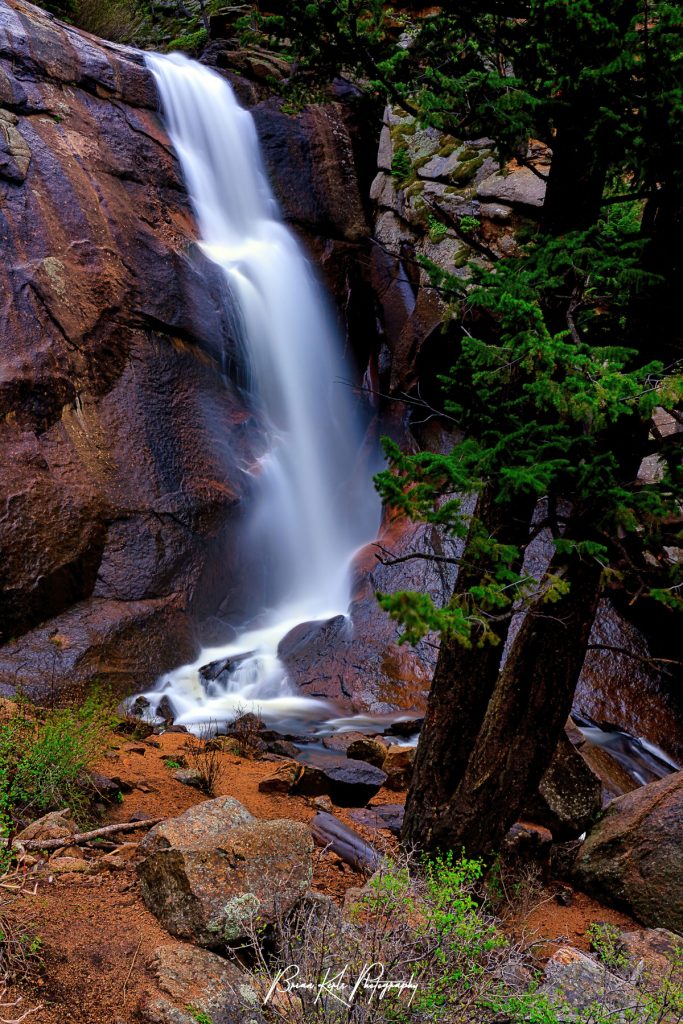
I almost turned around that morning. Rain on the windshield the whole drive out, and I spent most of it deciding whether the hike was worth it. It was, and the weather I’d been worried about is the reason this photograph exists. Clear skies would have blown out the white water and flattened the forest. The clouds did what no filter can.
This image carries well at size. Moving water holds detail that only really opens up when the image is large enough to stand in front of, and the greens stay saturated rather than going neon the way they can in direct sun. It suits a room meant for rest — a bedroom, a reading corner, a waiting room, a treatment space. Prints are available on paper, canvas, metal or acrylic, in sizes to 48×72.
Browse sizes and materials for Elk Falls, or see the rest of the Colorado landscape collection.
Other Colorado waterfalls I’ve photographed
Elk Falls is one of the largest waterfalls within reach of Denver, and like most Colorado waterfalls it’s at its best in a narrow window, when spring runoff is still feeding it. Catch that window and they all reward the same approach: overcast light, a tripod, and a shutter held open long enough to smooth the flow.
In Rocky Mountain National Park, Calypso Cascade sits in the park’s quieter southern end, and Granite Falls takes a long walk up the North Inlet to reach. “Dream Cascade” is my name for a small unnamed stretch of water below Dream Lake, the kind of thing most people walk straight past on the way to the lake view.
With its cliffside location, turquoise waters, and wispy waterfalls, Hanging Lake in Glenwood Canyon is a Colorado gem and one of the most photographed waterfalls in the state. Further to the southwest, Cascade Falls drops into Ouray at the edge of town.
Some of my favorites have no official names at all. They aren’t destinations, just places I stopped because the water was doing something worth photographing. “Alpine Waterfall”, “Double Falls” and “Forest Cascade” are all sections of Ben Tyler Creek in the Lost Creek Wilderness near Bailey. “Missouri Creek Cascade” and “Staircase Falls” are along Missouri Creek in the Holy Cross Wilderness. “Rocky Mountain Cascade” sits along the South Fork of Middle Boulder Creek in the Indian Peaks Wilderness. “Pitkin Creek Cascade” is just off the start of the Pitkin Lake trail above Vail.
Sometimes the water is the setting rather than the subject. “Autumn on Chalk Creek” and “Wildflower Cascade” both use the season around the stream as much as the stream itself.
See all my waterfall and lake prints here
Loved what you just read?
Become a VIP Insider and get more of the good stuff – exclusive tips, insider updates, behind-the-scenes stories, and special promotions delivered straight to your inbox.
Don’t miss out—our VIP members get the best of everything first

